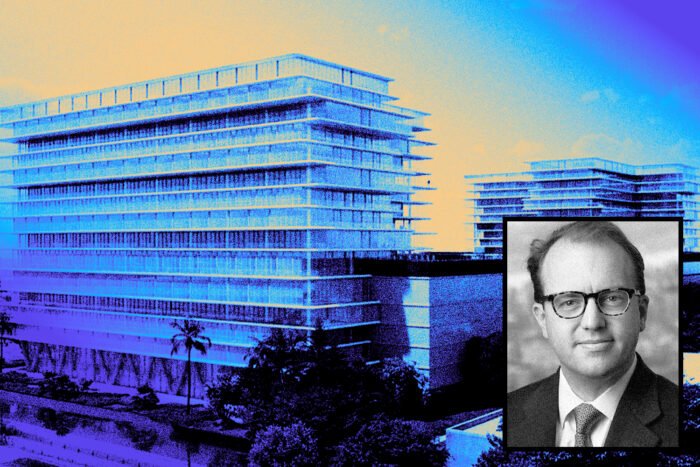

Developers David Martin and the Frisbie Group have moved a step closer to advancing their contentious One Boca mixed-use development.
On Thursday, the Boca Raton Planning and Zoning Board unanimously endorsed a 99-year lease, clearing the way for Martin’s Terra and the Palm Beach-based Frisbie Group to pursue One Boca—a large-scale project featuring 947 residential units, a hotel, and additional commercial uses on and around 7.8 acres of city-owned property near the Brightline train station.
The board’s 7-0 vote means the Boca Raton City Council will receive a favorable recommendation when the development agreement goes to council members for a first reading on January 6. If the council gives final approval, the lease will be presented to city voters for ratification on March 10.
According to a city memo, current plans call for the Frisbie Group, led by Rob Frisbie Jr. and Cody Crowell, and Terra to construct 765 apartments, 180 hotel rooms, 120,000 square feet of office space, a 30,000-square-foot grocery store, and 2,100 parking spaces on city land. The site is bounded by Palmetto Park Road to the north, Northwest Second Avenue to the east, Northwest Fourth Street to the south, and Northwest First Avenue to the west. The apartment complex, to be built at the current site of the Boca Raton Police Station at 101 Northwest Boca Raton Boulevard, would include 77 workforce housing units.
Additionally, Frisbie and Terra plan to develop a 210,854-square-foot mixed-use project with 182 condominium units on private land they are under contract to purchase. This 12,315-square-foot parcel at 141 Northwest Fourth Street is owned by Boca Color Graphics, headed by Michael A. Massarella.
Altogether, the One Boca project would bring just over 538,000 square feet of new development—substantially less than the original proposal put forward by Terra and Frisbie in February. At that time, after outbidding three other groups (including Related Ross), they were chosen to redevelop 30 acres that included the city’s aging city hall and the 17-acre Memorial Park. Their initial plan called for a 2.5-million-square-foot development with 1,129 residential units, 150 hotel rooms, 250,000 square feet of office, 156,690 square feet of retail, and 3,434 parking spaces.
Despite the downsizing, the project has continued to face strong opposition from residents. The group Save Boca gathered enough signatures to trigger a referendum requiring a special vote before any public land greater than a half-acre could be sold or leased. Although a judge later blocked the referendum on public land deals generally (a ruling Save Boca is appealing), city council members still agreed to let voters have the final say on the One Boca proposal.
Further changes came in October when Frisbie and Terra scaled the project back again, restricting new development to the east side of Northwest Second Avenue. The 17.5 acres on the west side, which include Memorial Park, will remain dedicated to public use and will feature a new city hall, community center, recreational amenities, a police substation, and a public parking garage—all to be built by Terra and Frisbie under the draft lease. The developer’s fee for these facilities will be negotiated later, but Terra and Frisbie have committed to providing $7.9 million in off-site public improvements.
For the right to build on the east side of Northwest Second Avenue, the developers would pay the city 7% of gross revenues from the residential component and 4% of gross revenues from the retail, office, and hotel components annually. Additionally, 10% of revenues above a certain “gross revenue hurdle” related to the developers’ costs would also go to the city.
Deputy City Manager Andrew Lukasik told the board that the lease provides the city with “strong default and termination rights.”
The developers assert that revenues from the project could generate more than $2 billion in rent, taxes, and related income for the city, according to their One Boca website. However, two project critics, both certified accountants, told the board they estimate the city would receive less than $50 million over 99 years.
Board members were instructed not to consider the financial aspects of the deal. Their review was limited to whether a 99-year lease, which would enable a transit-oriented development, aligns with the city’s comprehensive plan for the downtown area.
“You will not be evaluating the leases themselves in terms of economics, nor the criteria used to select its [developer] partner, nor evaluating the [developers’] ability to implement the project,” Lukasik said.
Board member Gergory Mitchell acknowledged his concerns about the financial side of the deal and urged city council members to “get the best bang for our buck.”
Board member Timothy Dornblaser argued that spurring development near the Brightline train station made sense, while board chairman Arnold Sevell commented that downtown redevelopment was “long overdue” in a city increasingly drawing interest from developers.
“We have good momentum and I think we should keep it moving,” Sevell said.
Opponents remain vocal. Save Boca founder Jon Pearlman told the board that public resistance to One Boca is so intense that voters will ultimately reject the project.
“We are in power. We are in control,” Pearlman said at the podium. “This is just a show, and it is meaningless and we have the ultimate say and vote.”