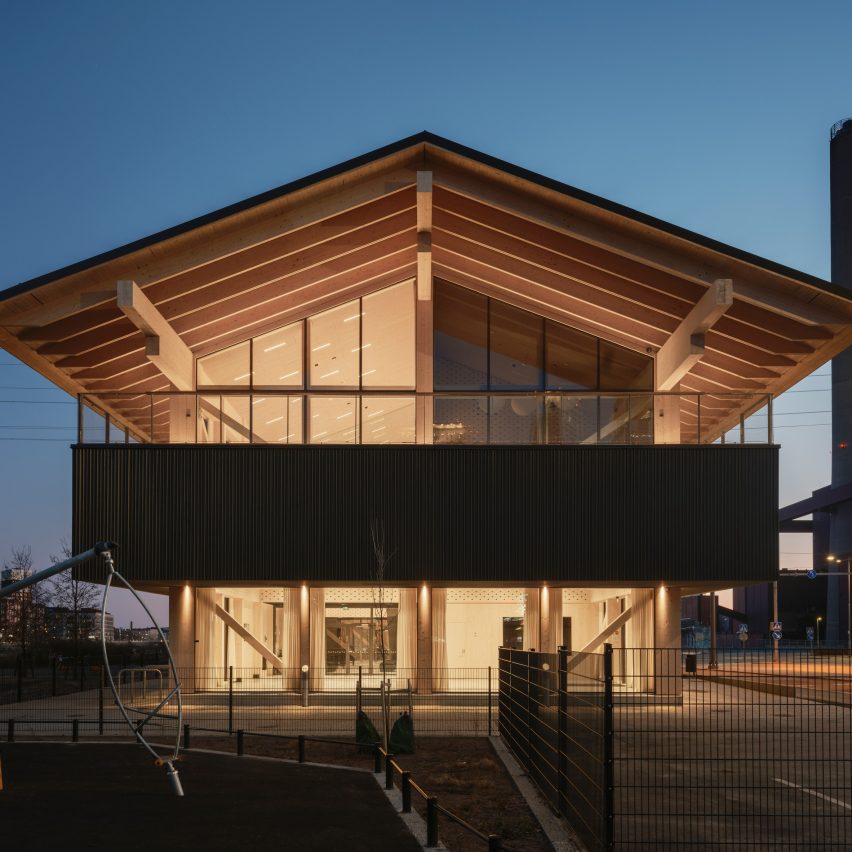

The exteriors of Insects and Bats, an education and wellness center in Hertfordshire, UK by London design collective Okira, feature irregular oak shingles that double as habitats for insects and bats.
Located in Surge Hill, Apple House was designed for local community interest company The Surge Hill Project, which aims to demonstrate how working with nature can transform people’s lives and well-being.

Located in the center’s warehouse-like volume is a multi-purpose learning and workshop space, a kitchen and an office, which overlooks the vegetable garden and educational “plant library” through large windows.
Okira chose rough, hand-hewn oak skins to cover the exterior of the Apple House as part of a material palette that seemed to showcase the potential of local, natural materials, including a spruce wood frame, hempcrete and clay and straw bricks.

The project was recently shortlisted in the Design Awards 2025 Leisure and Wellbeing Project.
“We wanted to find something that could be made immediately available on site with natural materials that was resourceful, practical and beautiful,” Okira co-founder Ben Stuart Smith told Dezeen.

“Apart from above ground and its corrugated aluminum roof, the Apple House is made entirely of natural materials,” added Stuart Smith.
“It takes the form of a traditional barn with a 45-degree pitch black corrugated roof, meaning that from a distance it looks like a typical agricultural building. But when you get closer, the building is revealed as something more complex, crafted and expressive.”

The Apple House’s exterior shingles were all produced from oak trees in nearby congested areas, cut into lengths that could be processed entirely by hand. The gaps created by the wavy, irregular shapes of shingles double as habitats for insects and bats.
These shingles cover a spruce frame that forms the structure of the building, which is infused with hempcrete to form the exterior walls. Internal partitions were constructed using birch ply panels, with a large storage wall added behind the kitchen.
A wall of folding wooden doors enables the kitchen to be closed off from the multipurpose hall, while shutters in the upstairs office mediate its connection to the rest of the center.
The Apple House floor was developed in collaboration with natural materials expert Will Stanwycks, by taking mud and straw bricks, or “strokes” produced by local brickmaker HG Matthews, and cutting them in half to make tiles that were then sealed with linseed oil.

Due to a one meter level change across the site, the center sits partly on a brick plinth to keep the ground floor of the building on one level, with frame paths and ramps created to ensure access.
The plant library which surrounds the center was developed by landscape practice Tom Stuart Smith Studio and contains over 1,500 different plant species, intended to be used as an educational resource for anyone interested in plants and plant design.

Other buildings recently featured on Design that use local, natural materials include the Hadeskov Living Lab in Denmark, which features a palette by Dejernes & Bell that includes local hemp, clay, sand, and wood.
Van Latham Architecten also used both shingles and hempcrete to build their garden studio in Belgium.
Photography by Nick Dearden.