
TAKK’s multispecies landscape takes over MAXXI
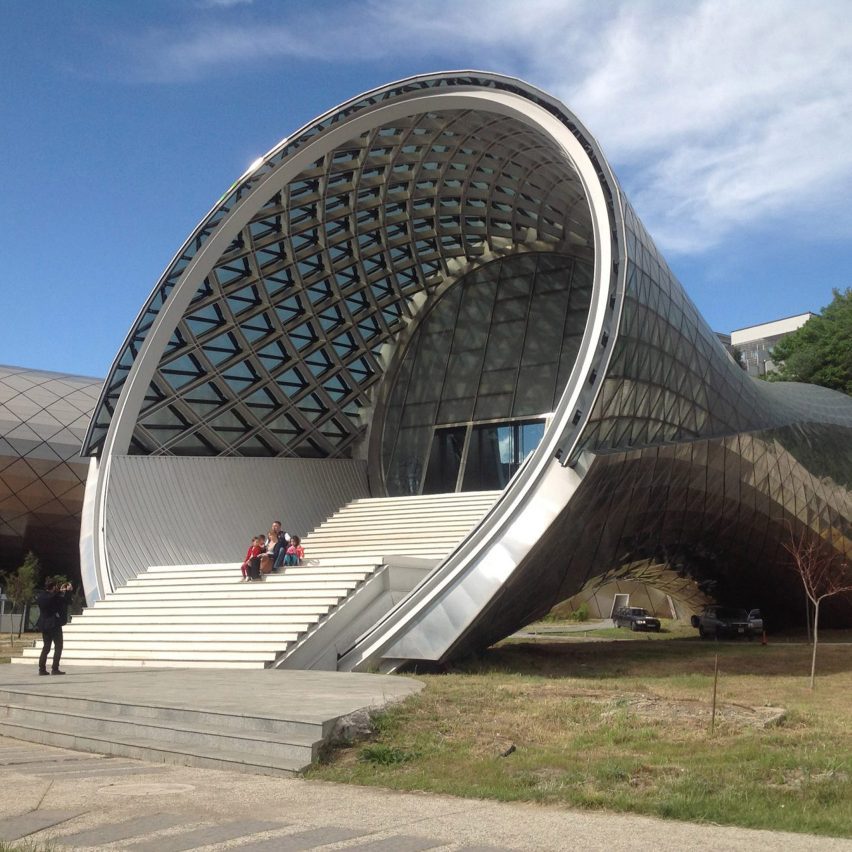
The first thing visitors encounter inside Zaha Hadid-designed MAXXI – National Museum of 21st Century Arts is a garden of signage and vegetation, glowing grow lights, circular sofas made for collective rest, and edible plants climbing upward through metallic structures. With con-vivere, the Barcelona- and New York-based studio TAKK transforms the Roman institution’s entrance hall into a landscape where architecture becomes an instrument for coexistence.
Presented as the second chapter of ENTRATE, the long-term program curated by Martina Muzi for MAXXI’s Architecture and Design Department, the installation acts like an environmental condition. TAKK’s con-vivere frames ecology as something relational and bodily and proposes a spatial strategy grounded in care, reciprocity, and interdependence. Circular forms replace rigid geometries, greenhouse luminaires nourish vegetation and human bodies and aromatic species diffuse scents through spaces designed for slowness and attention.

all images by José Hevia
six installations invite visitors into slower forms of coexistence
Founded by architects Mireia Luzárraga and Alejandro Muiño, TAKK has long explored how ecological systems can reshape the politics of space. Here, that research materializes through six mobile installations that invite visitors to rest, work, gather, meditate, and eat together among plants, scents, water, and artificial light.
The Fountain, a former jacuzzi reimagined as a shallow communal basin, centers the installation, a spot where visitors gather around water as both a social and ecological agent. Tiered seating wraps around the structure, embracing pause while the sound of moving water cuts through the vast concrete hall of the museum. Nearby, The Collective Sofa stretches into a six-meter-wide circular landscape for lying down, reading, or sleeping beneath a suspended garden of aromatic plants. Visitors are instructed to remove their shoes before stepping inside, shifting the bodily etiquette of the museum from circulation toward intimacy.

The Collective Sofa creates a circular landscape for rest beneath suspended gardens and soft lighting
agriculture, meditation, and workspaces merge inside con-vivere
The Tower stages food production as a collective ritual. Edible Mediterranean species, including asparagus, peas, and cabbage, grow across stacked platforms irrigated from water reservoirs above. Beneath the hanging crops, communal tables host moments of gathering around food sovereignty and the invisible systems that sustain urban life. In TAKK’s hands, agriculture becomes spatial infrastructure rather than background scenery.
The softer moments of con-vivere are perhaps its most radical. Inside The Wellness Bed, visitors experience guided meditation surrounded by medicinal and psychoactive plants, scent diffusers, chromatic lighting, and sound. Care comes from the exchange between bodies, atmospheres, and living organisms, not a well-structured routine. The architects even reframe productivity through The Work Table, where exposed structural systems inspired by bridges and beams support a shared illuminated workspace that merges concentration with collectivity.

chains, timber structures, and hanging vegetation frame a multisensory environment
softer ways of inhabiting public space
Across the installation, TAKK assembles provisional scenarios for living together differently amid ongoing environmental transformation. Metallic structures coexist with flowering species. Lightweight low-carbon materials support dense sensory environments. Color operates simultaneously as therapy, stimulation, and orientation. Architecture becomes more about maintaining fragile relationships between humans, objects, infrastructures, and ecosystems.
There is also something quietly subversive about placing these gestures inside the entrance of a museum institution. Visitors arriving at MAXXI expecting transition instead encounter stillness. The lobby, often perceived and treated as a space of efficiency, movement, and consumption, here becomes somewhere to linger barefoot beneath hanging gardens or sit collectively around water.
In a cultural moment shaped by exhaustion, ecological instability, and hyper-productivity, TAKK’s intervention suggests that rest, care, and coexistence are active spatial practices.

plush circular seating invites visitors to rest collectively beneath suspended floral installations

The Fountain reimagines a former jacuzzi as a communal gathering space

TAKK combines ornamental surfaces with lightweight structural systems