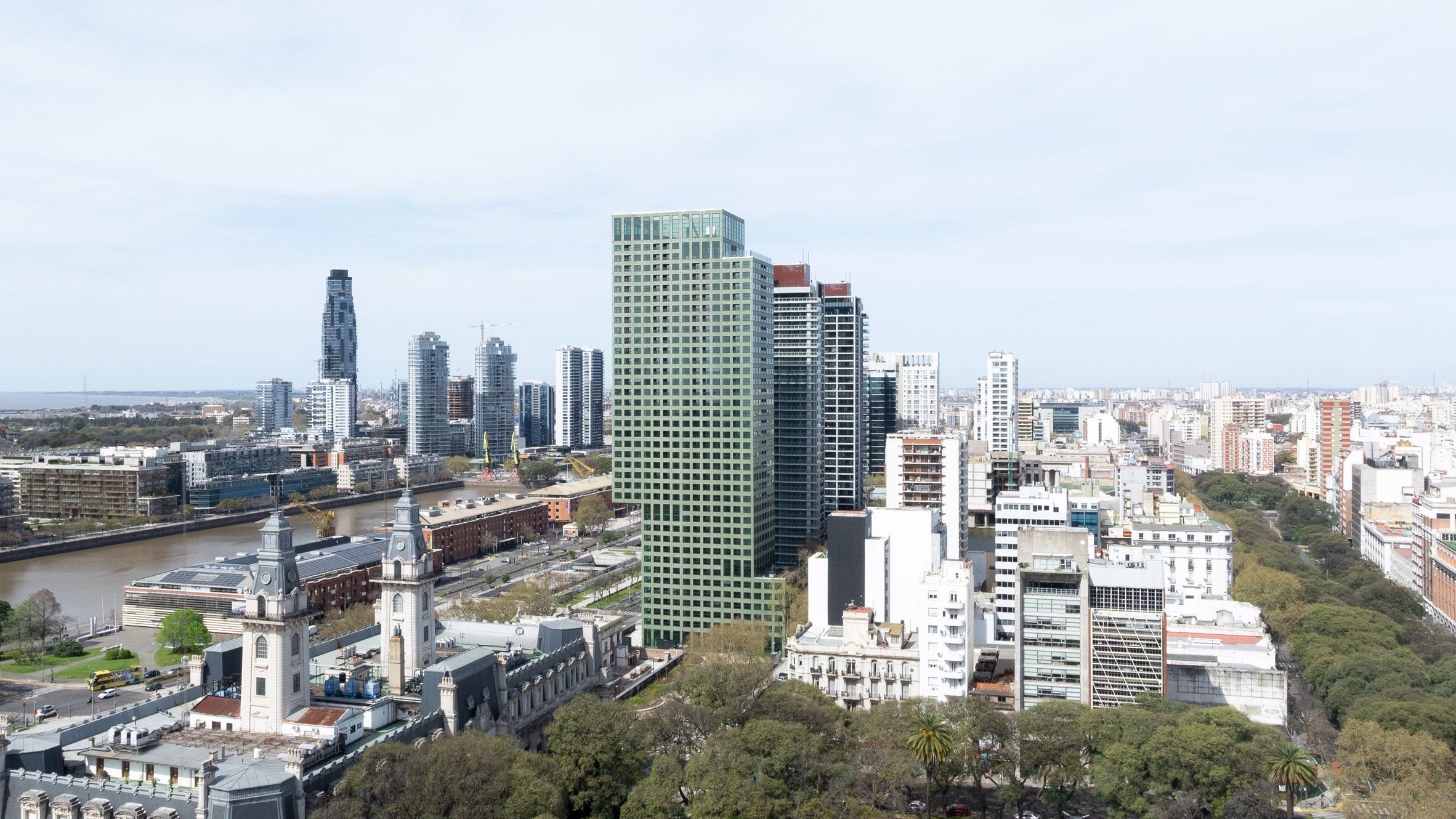
Local architecture studio Adamo Faiden has completed Huergo 475, a residential skyscraper in Buenos Aires, Argentina, featuring a green-pigmented concrete facade and prominent cantilevered forms.
The tower’s exposed concrete facade serves a dual purpose: it is both structural and visually monolithic, designed by Adamo Faiden to integrate harmoniously with the surrounding cityscape.

“The exposed concrete facade serves a structural role while simultaneously defining the project’s identity,” said studio co-founder Marcelo Faiden in an interview with Dezeen.
“To achieve a monolithic effect, we developed a grooved-textured formwork, which visually softens the appearance of the concrete and its construction process.”

Standing 120.6 metres tall, Huergo 475 comprises 39 floors and houses 507 apartments. The building is situated in northeast Buenos Aires, bridging the dense urban fabric and the adjacent ecological reserve.
The tower presents two distinct profiles: one side appears broader, while another is noticeably slender. Its structure includes a central core with lightweight, beamless floor slabs, as described by the studio.

In certain areas, the facade is subtly faceted to reduce what Faiden described as the “dizzying” sense of horizontal expanse.
The building features a sequence of double-height spaces and dramatic cantilevers, referred to by Faiden as “horizontal shifts.” These elements were designed to respond directly to the building’s context.
All public amenities—including a gym, coworking area, and communal kitchen—are located within these cantilevered sections.

These communal zones are distinguished by double-height windows, which contrast with the single-level window openings, resulting in a varied pattern across the facade.
At ground level, Huergo 475 incorporates a public passageway adjacent to retail spaces, inviting both residents and the public to engage with the building.