factory 5.0: a pavilion shaped by biological intelligence
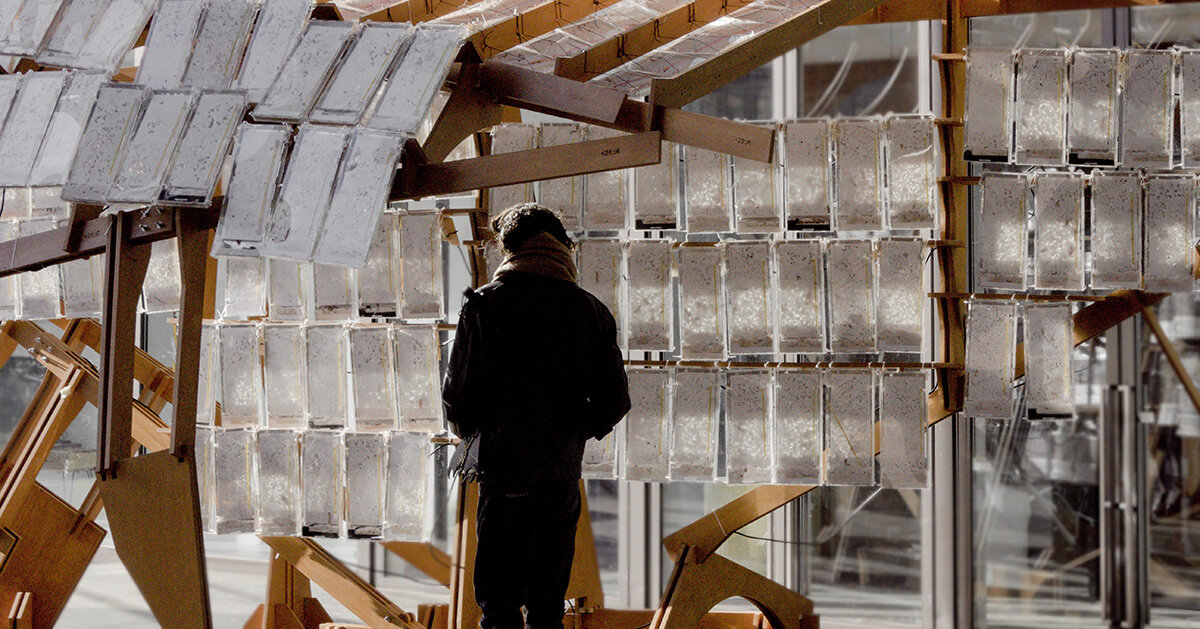
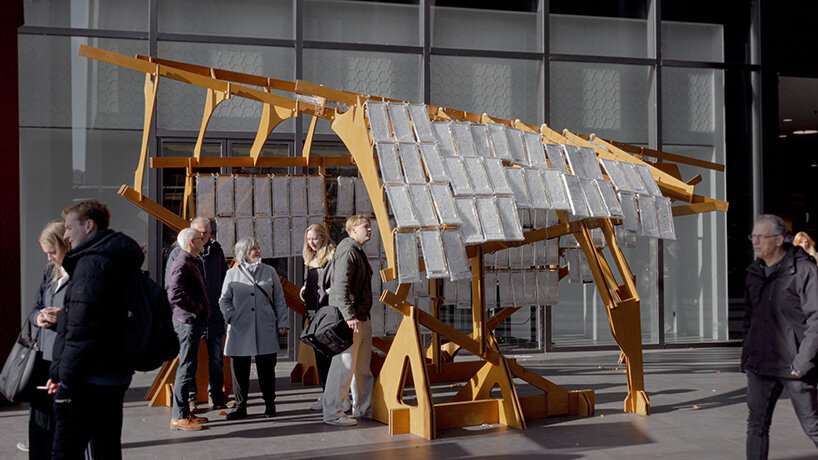
Studio Aditya Mandlik (SAM)’s Factory 5.0 is a timber pavilion that reimagines biological intelligence as a genuine design collaborator. The project is co-authored by 10,000 king worms, which metabolize Styrofoam in real time. “When we design built environments, we are reshaping the planet’s outermost skin—one that has always supported complex, multi-species life,” the architect shares with designboom. “My instinct is to design in dialogue with that broader ecological knowledge system.”
Studio founder Aditya Mandlik describes Factory 5.0 as an invitation to reconsider architectural authorship in the era of the Fifth Industrial Revolution, a time shaped by the merging of human and non-human intelligence. “Making is no longer a linear, directive process; it becomes a co-evolution shaped by multiple intelligences operating simultaneously across material, biological, and spatial scales,” the architect observes.
Central to the installation is plastic—the defining material of the First Industrial Era—transformed here through decomposition. “Plastic became a lens to understand how drastically our intentions and consequences can diverge,” Mandlik explains. “Working with worms revealed that nature already holds pathways for metabolising what we consider irreversible problems.” In conversation with designboom, Mandlik frames Factory 5.0 as a platform for reimagining material futures, expanding architectural possibilities through decomposition.
all images courtesy of Studio Aditya Mandlik
how worms reshape the geometry of the structure in real time
Factory 5.0 consists of 546 digitally fabricated timber elements interwoven with 200 Styrofoam plates, all contained within transparent acrylic chambers. These interior spaces serve as active environments where worms—treated as project collaborators—continuously alter the pavilion’s geometry. “Their behavior resembled that of micro-sensors, constantly recalibrating in response to temperature, light, and moisture,” Mandlik explains. “These feedback loops began to dictate the pavilion’s evolving porosity.” As a result, the architecture transforms dynamically, offering visitors changing spatial experiences as they move around and through the structure.
Unanticipated behavioral patterns quickly became part of the design language. The worms clustered for warmth below 20°C, moved toward darkness, and even underwent metamorphosis when isolated—phenomena that influenced the rhythm of the space and the rate of material decay. “Designing with decomposition required accepting that everything we create should ultimately be able to return to natural systems,” the Mumbai-based architect tells designboom. This philosophy guided choices from assembly strategies to the pavilion’s portability. Factory 5.0 was already in its second iteration at DDW, having been flat-packed, transported, and reassembled following its initial showing in Mumbai.
This adaptability also shapes the project’s afterlife. “Disassembly is not the end of a project, but the beginning of its next metabolic phase,” Mandlik notes. After the exhibition, the timber parts are reused, while the worm-transformed Styrofoam plates—now responsive to light, sound, and human presence—are kept as mementos and later serve as molds for casting metal lights. Factory 5.0 thus models regenerative architecture, where biological and technological intelligence co-create our spaces. Read the full Q&A below.

a timber structure that positions biological intelligence as a genuine collaborator
Interview with Aditya Mandlik
designboom (DB): Factory 5.0 introduces worms as active co-creators. What first prompted you to explore biological intelligence as a design partner?
Aditya Mandlik (AM): For me, working with non-human intelligence has always been a natural extension of architectural practice. When we shape built environments, we are essentially reshaping the planet’s outermost layer—a surface that has long sustained complex, multi-species life. My instinct is to engage with that larger ecological knowledge system in the design process. With Factory 5.0, this dialogue became even more significant. Since the installation was envisioned as a prototype for architecture in the era of the Fifth Industrial Revolution, we decided to collaborate with natural decomposers to process single-use plastic—a hallmark material of the First Industrial Era. In this way, decomposition became both the design method and the message, presenting architecture as a metabolic, co-authored process rather than one solely directed by humans.
<img decoding="async" class="wp-image-1168559 size-full lazyload" bad-src="data:image/gif;base64,R0lGODlhAQABAIAAAAAAAP///yH5BAEAAAAALAAAAAABAAEAAAIBRAA7" alt="aditya mandlik on how decomposition becomes design method in worm-driven architecture" width="818" height="460" src="https://static.designboom.com/wp-content/uploads/2025/12/aditya-mandlik-decomposition-design-method-worm-driven-architecture-interview-designboom-03.jpg" srcset="https://static.designboom.com/wp-content/uploads/2025/12/aditya-mandlik-decomposition-design-method-worm-driven-architecture-interview-designboom-03.jpg 818w, https://static.designboom.com/wp-content/uploads/2025/12/aditya-mandlik-decomposition-design-method-worm-driven-architecture-interview-designboom-03-768×432.jpg 768w" data-sizes="auto"