Skypark Business Center by BIG Nears Completion in Luxembourg
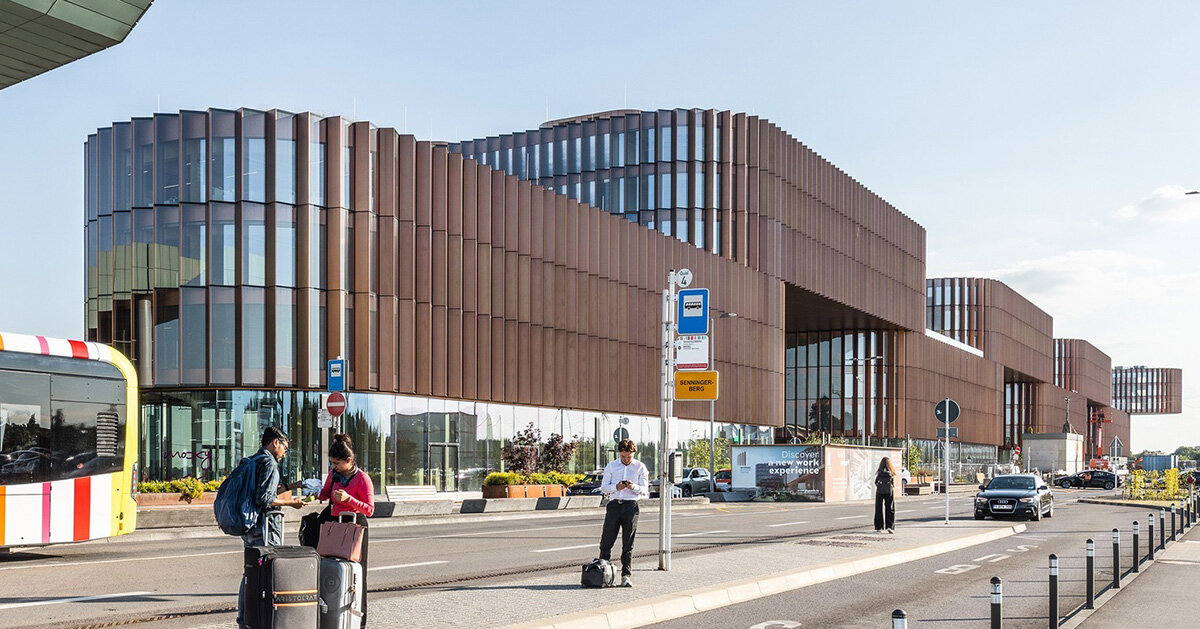
The third and final phase of the Skypark Business Center (SBC) in Findel, designed by Bjarke Ingels Group (BIG), is progressing toward completion, marking the imminent unveiling of one of Europe’s largest mass-timber structures. The 70,000-square-meter complex stands adjacent to Luxembourg Airport, presenting a striking, seven-story silhouette constructed from more than 15,000 cubic meters of wood—a volume the project team likens to filling six Olympic-size swimming pools.
Beyond its impressive scale, the project is notable for its distinctive architectural form. Rather than a continuous zig-zag, the design features two timber bars, stacked and rotated, that interlock and slide past one another. This composition generates a dynamic sequence of terraces, courtyards, and expansive workspaces with panoramic views overlooking the runway and the Grand Ducal Golf Course.
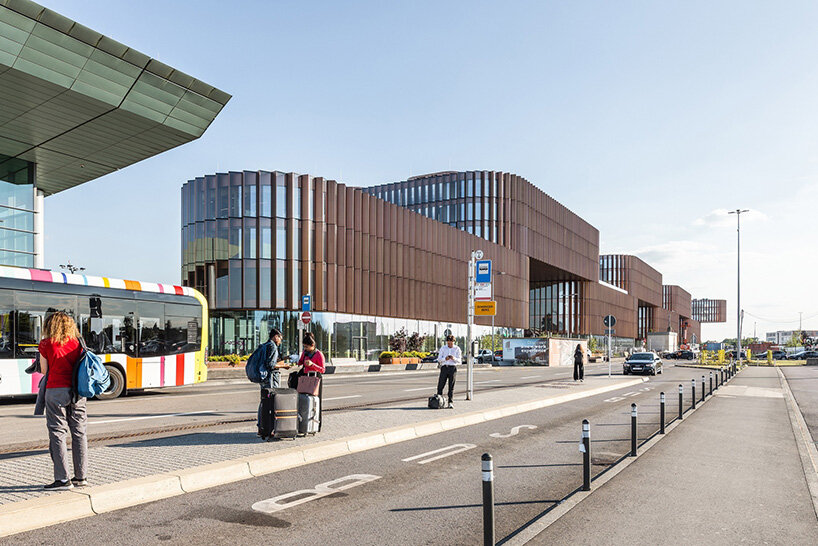
all images by @corentinhaubruge
An Undulating Urban Anchor Shaping the Edge of Airport City
At the urban scale, SBC serves as a central anchor for the Airport City Masterplan within the municipality of Niederanven. The BIG team worked within the constraints of a long, narrow site—spanning approximately 19,000 square meters—and adhered to a strict height limit of 30.5 meters, shaping a building that acts as both a workplace and an infrastructural buffer. In profile, the structure appears as an undulating wall: its shifting form offers acoustic protection for surrounding public spaces and future developments, while also allowing daylight, greenery, and movement to permeate the site despite its proximity to one of Luxembourg’s busiest transit hubs.
The building’s volumes are clearly stratified: a robust parking plinth forms the base, topped by a fully glazed ground level that welcomes pedestrians, and two copper-clad office bars sweep across the upper stories. The stacked zig-zag formation is a practical design choice rather than mere visual interest—each rotation introduces new outdoor spaces, including green terraces every 50 meters, sheltered alcoves, and private internal courtyards that greet visitors arriving from the north. Rounded corners at each junction prevent dead ends and open up broad, panoramic views, supporting the concept of a flowing, continuous workspace over a rigid commercial block.
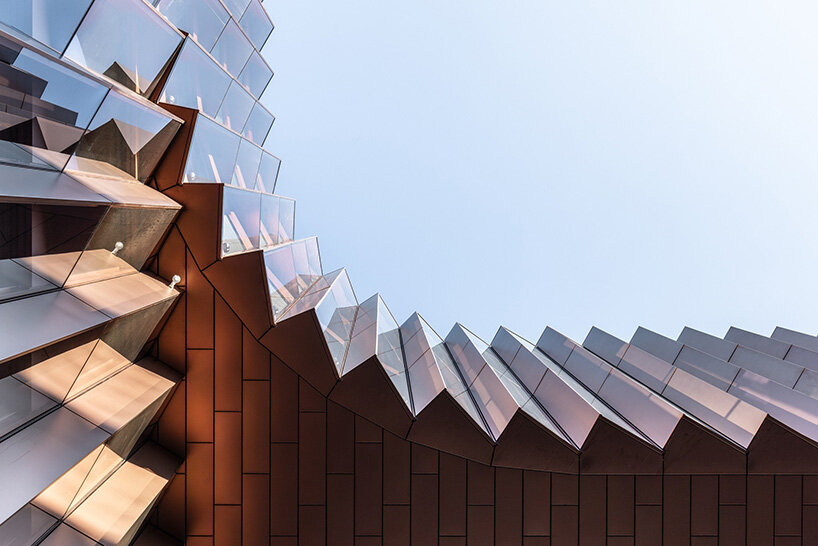
one of Europe’s largest mass-timber buildings
A Flexible Workspace Defined by Overlapping ‘Snakes’
Inside, the building’s layout is intentionally flexible. All circulation cores are positioned at the intersections where the two ‘snakes’ overlap, ensuring every tenant enjoys direct vertical access without disrupting the continuity of the floorplates. This design supports adaptable office configurations, allowing spaces to be easily reconfigured to match tenants’ evolving needs. Upon arrival, visitors enter through a double-door portal into the Grande Galerie—a spacious internal corridor that runs along the building’s spine. This area features a lively mix of restaurants, retail outlets, and a fitness studio, all set along a glazed edge that opens toward the southern gardens and provides clear views of the 4-kilometer runway.
The SBC is seamlessly integrated with airport operations. On the east, a lightweight canopy stretches from the ground floor to connect with Terminal A’s departure level, providing a sheltered pedestrian link and landscaped plaza for both travelers and employees. Below, on level B1, car rental and valet services are housed in a bridge-like structure, allowing passengers to collect vehicles just minutes after landing. To the west, the upper bar cantilevers outward, forming a striking architectural gateway and a shaded public entry for those arriving from central Luxembourg.
Three layers of rooftop gardens crown the building, offering occupants access to greenery and fresh air at multiple levels. Alongside the extensive use of mass timber in the upper structures, bridges, and floor slabs, these outdoor spaces reflect the SBC’s broader mission: to illustrate how large-scale workplaces can embrace lower-carbon construction methods while fostering healthier, more nature-connected environments.
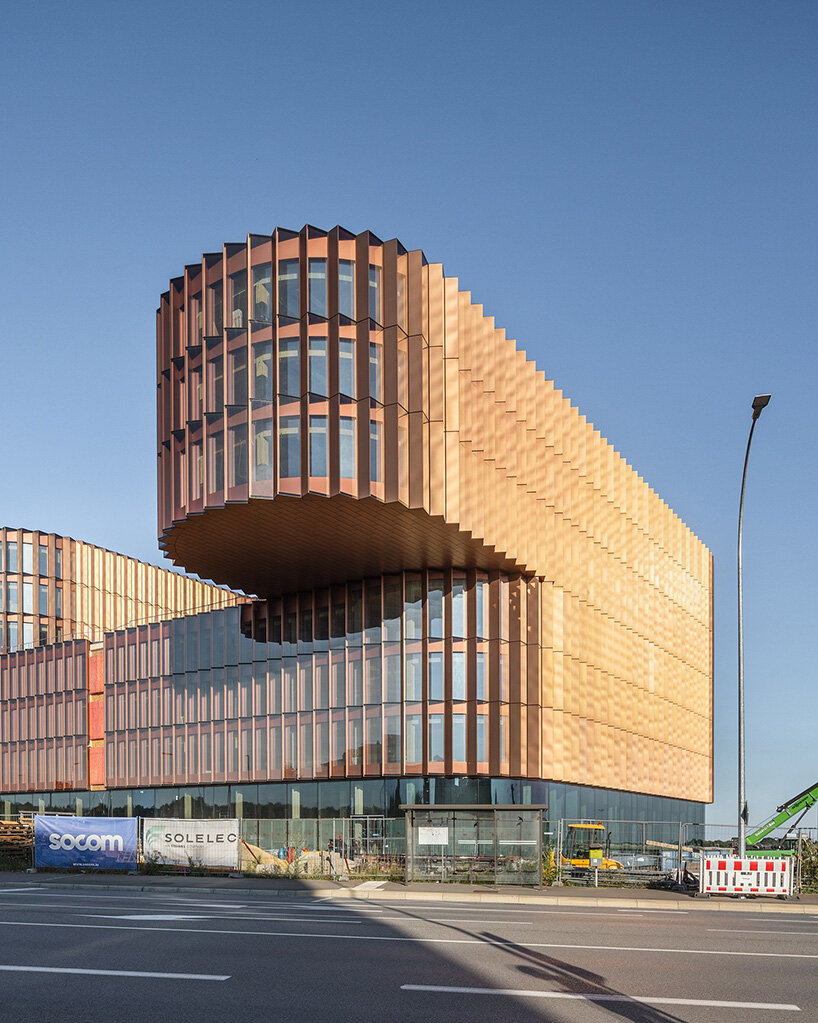
a sculptural, seven-story landmark built from more than 15,000 cubic meters of wood
<img decoding