
Architect Alexandra Hagen is stepping down as CEO of the prominent Swedish firm White Arkitekter. In this exclusive interview, she discusses the experiences, influences, and core values that have shaped her journey in architecture.
“In my early 30s, I led our international division and would often meet people, mainly men who were 20 years my senior, and they had absolutely no expectations of me,” Hagen shared with Dezeen.
“They would see me and think, ‘Who’s this young blonde woman? She probably doesn’t know much.’ No one anticipated that I would accomplish anything, and they were genuinely surprised when I did,” she recalled.
Instead of letting these biases discourage her, Hagen chose to see her unique position as a young woman in a male-dominated industry as an advantage.
“If you’re the only woman in the room, people will always remember you because you stand out,” Hagen explained.
“You have to learn how to use your differences to your benefit. And that doesn’t just apply to gender—it can be any kind of difference,” she added.
“Gender equality is only one facet of the inequalities we see, but building the confidence to use your differences as strengths is essential.”
Hagen began at White Arkitekter as a junior architect
Hagen graduated in architecture from Chalmers University of Technology in 2000 and soon after started her career at White Arkitekter in 2001 as a junior architect.
The award-winning firm, established in 1951 by architect Sidney White in Gothenburg, has grown to employ over 900 people, making it one of Scandinavia’s largest practices.
Initially, Hagen planned to stay for just a year or two, hoping to gain experience before starting her own studio. Instead, she has remained with the company for 25 years.
“I thought I would work at White for a couple of years, learn what I could, and then open my own practice,” Hagen admitted.
“But White turned out to be an incredible place to work,” she continued. “I’ve held several architectural roles across different sectors and taken on various leadership positions throughout my career.”
After nearly eight years as CEO, Hagen will step down from her role in 2026, coinciding with the studio’s next strategic phase.

On her way to becoming CEO, Hagen served as head of White Arkitekter’s Malmö office and as international director for UK business development.
During this time, she’s seen the working environment for women in Swedish architecture improve, noting that gender equality is “one of the cornerstones of Swedish society.”
“I believe the gender balance in Swedish architecture is now 50-50. In fact, female architects in Sweden are paid more than their male counterparts,” Hagen observed.
Ensuring gender balance and equal opportunities for all employees has been a key priority at White Arkitekter. In recent years, this has included encouraging male architects to take parental leave, which helps reduce the stigma around hiring women who may wish to start families.
“Supporting men in being good fathers is crucial. When men take equal responsibility at home, the difference disappears,” Hagen said.
“When men take more parental leave, women take less, so things naturally become more balanced. It’s not just about empowering women—it’s about supporting men too.”
“Guided tour of the Pantheon” inspired Hagen’s career path
Hagen credits her grandparents for inspiring her interest in both the humanities and sciences—interests she believes are uniquely united in architecture.
Her paternal grandparents introduced her to opera, orchestral music, literature, and art.
“My grandmother never took me to playgrounds. She’d say, ‘You can choose between the opera, the city library, or the city art hall’,” Hagen recalled.
On her mother’s side, her grandparents were mathematicians and physicists. She fondly remembers sharing dinners with “crazy scientists” who stayed at their house.
“I loved both these worlds. I used to wonder, ‘How will I ever choose between these two great passions?'” Hagen said.
It was a teenage trip to Rome that helped her find the answer.
“As a young teenager, I visited Rome and took a guided tour of the Pantheon. The guide explained how the building had been central to Rome’s spiritual life for 2,000 years, and that it was also a technical marvel for its time,” she said.
“That’s when I realised architecture perfectly combines science and art—this could be my world.”
“The trick is not to point the finger”
Hagen sees architecture as “a tool to improve people’s lives,” but stresses it must be done with respect for the natural world.
This philosophy, she explained, has driven everything at White Arkitekter since the 1990s, and is a key reason she has stayed with the company.
“Humanity must be part of the natural world, understanding our place and our dependence on nature to survive and thrive,” Hagen said.
“The greatest inspiration for designing cities is the forest. Nature is the ultimate designer, and there is so much we can learn from it.”
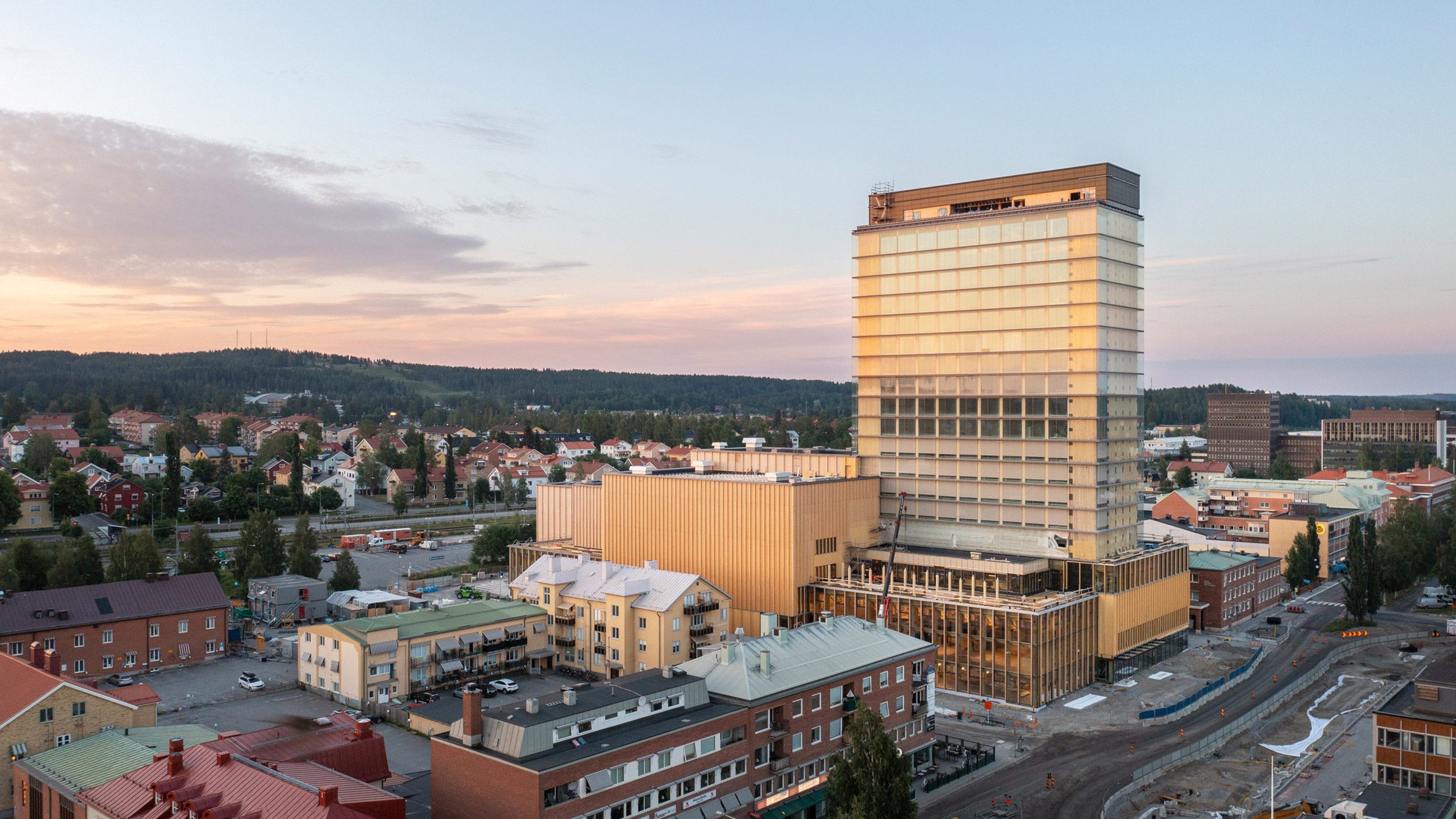
This mindset is reflected in projects like the mass-timber Sara Kulturhus Centre, which Hagen said helped transform attitudes toward wood in architecture, and in the firm’s work on relocating the city of Kiruna as a model for sustainable urban development.</