lima house: A Horizontal dwelling in a Chilean Valley
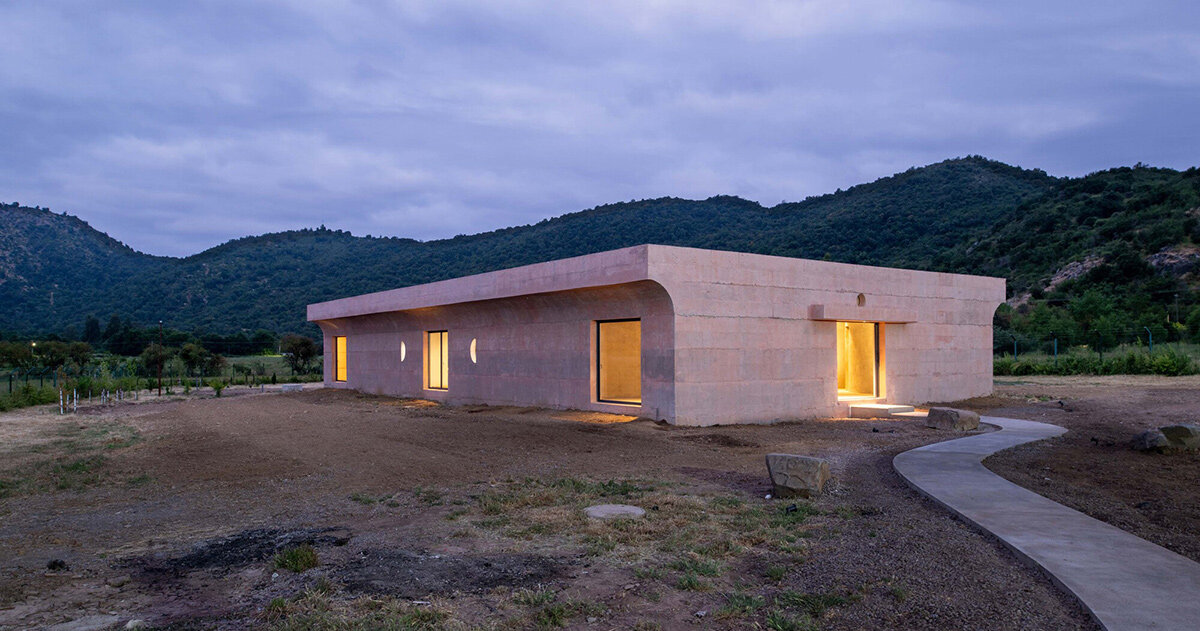
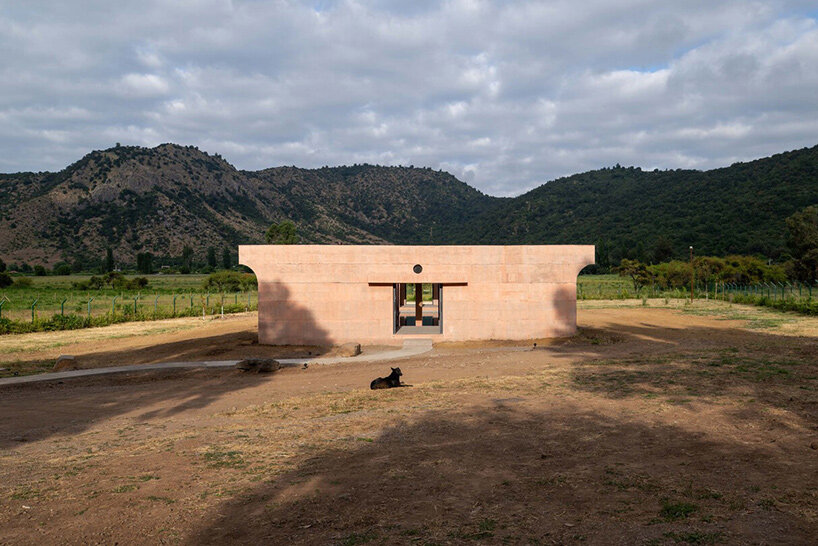
Pezo von Ellrichshausen’s newly completed LIMA House rises in a rural valley of central Chile, surrounded by expansive farmland bordered by vineyards and rugged hills. Its defining feature is a singular horizontal volume, elevated gently above the terrain—a minimalist gesture that draws a striking line across the vast, stony landscape.
The house extends with purpose across the site, its design marked by restraint. At its heart, a slender courtyard is oriented to capture the sunrise and sunset. Within this open space, a long swimming pool reflects light into the adjacent rooms, infusing the interiors with a shifting, tranquil shimmer as the day progresses.
images courtesy Pezo von Ellrichshausen
Pezo von Ellrichshausen’s courtyard home
Inside, the LIMA House unfolds as a sequence of spaces that are both understated and subtly intriguing. The architects’ symmetrical approach to the entry rooms grounds the layout, while each corner features a circular chamber. This geometric order gradually softens, and the distinction between interior and exterior becomes increasingly seamless.
This sense of transition shapes how the home is experienced. Movement flows naturally toward the courtyard, with thresholds that feel effortless and non-hierarchical. The pool emerges as the organizing centerpiece, anchoring the rhythms of daily life around its presence.
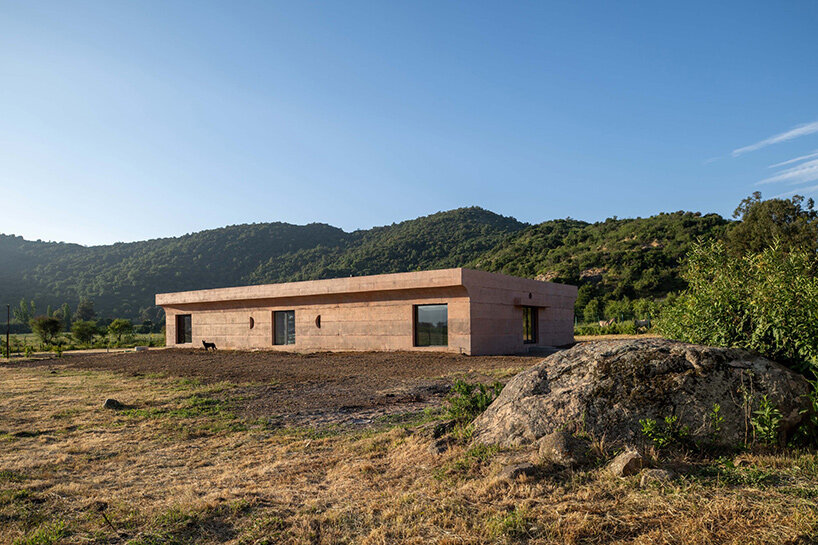
the house forms a single horizontal volume raised lightly above the farmland
the intertwined floorplan of looping rooms
The dwelling asserts its horizontality, resting just above the ground to create an unbroken ring of rooms. Circulation through these interconnected spaces forms a continuous loop, reinforcing the project’s intentional simplicity. The architects liken the overall plan to overlapping alphabetic shapes—a subtle motif that emerges in the building’s geometry.
While the design is clearly disciplined, the experience inside is gentle and calm. Each room is strategically opened to frame views of sloping vineyards and distant rocky outcrops, connecting the interior to the landscape without disrupting a sense of tranquility.
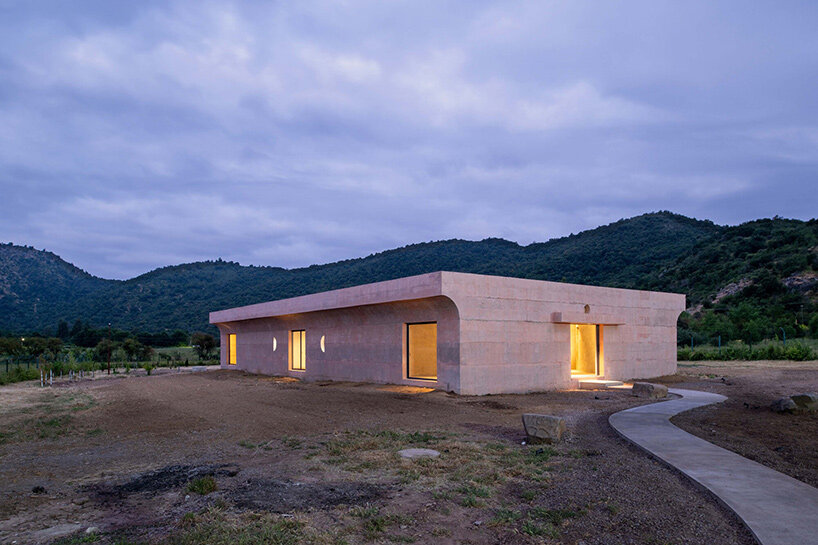
symmetry at the entry gives way to a softer transition between interior and exterior
a structure of curving concrete
Generous punch windows are carefully positioned to direct outward views. Their orientation brings daylight into the home by projection rather than diffusion, highlighting the thoughtful alignment of the structure. A curved concrete eave accentuates this effect, deepening the shadows and emphasizing the subtle shifts as one circles the building.
Material contrasts further define the home’s character. Inside, walls are finished with painted wooden boards, their soft texture moderating the brightness of the central courtyard. The exterior, by contrast, features cast-in-place concrete walls tinted with a delicate pink hue, their surfaces bearing only the marks of the formwork lines. This difference accentuates the threshold between the protected indoors and the surrounding open landscape.
The house is intended as a permanent residence for a retired couple, whose everyday activities will revolve around the central courtyard. In this way, LIMA House revisits a recurring typology in Pezo von Ellrichshausen’s body of work—an ordered perimeter encircling an open, resonant core.
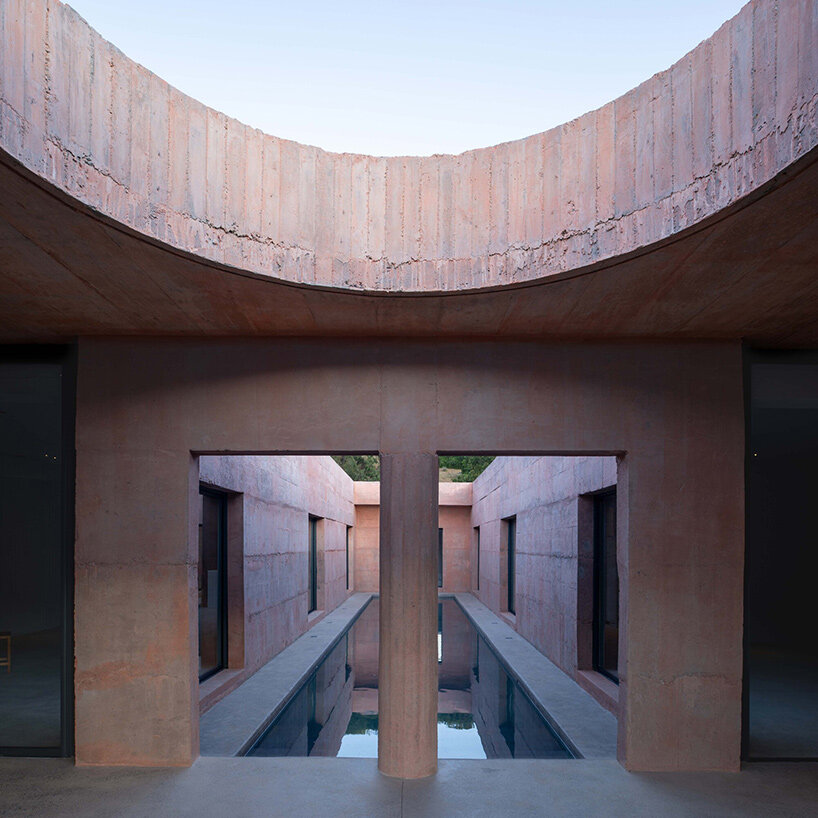
a narrow courtyard with a long pool organizes the plan and guides daily movement
<img decoding="async" class="wp-image-1168268 size-full lazyload" bad-src="data:image/gif;base64,R0lGODlhAQABAIAAAAAAAP///yH5BAEAAAAALAAAAAABAAEAAAIBRAA7" alt="pezo von ellrichshausen lima" width="818" height="818" src="https://static.designboom.com/wp-content/uploads/2025/12/lima-house-pezo-von-ellrichshausen-chile-designboom-04.jpg" srcset="https://static.designboom.com/wp-content/uploads