
lanza atelier revisits an ancient precedent for a serpentine
As LANZA atelier unveils ‘a serpentine’, the 2026 Serpentine Pavilion in London’s Kensington Gardens, the Mexico City-based practice proposes an architecture shaped as much by restraint as by form. Conceived for the 25th edition of the celebrated commission, the pavilion takes its name and organizational logic from the serpentine, or crinkle-crankle wall, a historic construction technique whose undulating geometry transforms a simple brick wall into a structure of remarkable strength, efficiency, and spatial richness. Through an interview with designboom, founders Isabel Abascal and Alessandro Arienzo reflect on material economy, beauty, permeability, and the social possibilities of architecture.
For LANZA atelier, the project began with a surprising discovery. While researching the commission, the architects encountered the English architectural feature that shares its name with both the nearby lake and the institution. The crinkle-crankle wall, characterized by its alternating curves, originated in Ancient Egypt before being introduced to England by Dutch engineers centuries later. Beyond its visual appeal, the wall carries a practical intelligence that immediately resonated with the architects.
Brick becomes the primary material and conceptual instrument of the project. While often associated with permanence, mass, and enclosure, LANZA atelier deploys it in ways that challenge those assumptions. ‘We are using brick walls, made from clay, to highlight artisanal construction methods as tried-and-true technologies for our collective present,’ the architects explain. ‘But these walls, rather than monumental and opaque, are permeable and unapologetically graceful.’
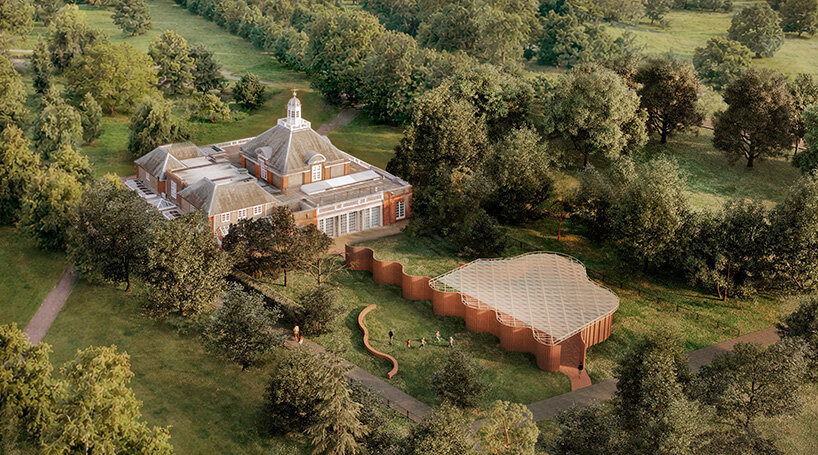
Serpentine Pavilion 2026 a serpentine, designed by Isabel Abascal and Alessandro Arienzo, LANZA atelier | design renders © LANZA atelier. courtesy Serpentine
rethinking brickwork for the 2026 seprentine pavilion
‘By virtue of its sinuous shape, the serpentine wall is recognized for requiring fewer bricks than a straight wall, as its winding geometry introduces lateral support to an otherwise flimsy one-brick-wide structure,’ they explain. In agricultural settings, these walls often function as fruit walls, absorbing warmth throughout the day and releasing it during the night to create protected growing environments. ‘The structure employs less while providing more,’ LANZA atelier continues, ‘which is a timely lesson for our current era of overconsumption.’
Yet the architects were equally fascinated by the convergence of meanings surrounding the word itself. ‘It’s quite magical that the same word gives name to a water feature, a lake, to a place, Serpentine, and to an architectural element, a wall,’ the Mexican duo tells designboom. The connection feels particularly resonant given the symbolic role of the serpent within Mesoamerican cosmologies. ‘This is the first time that a Serpentine Pavilion actually revolves around the serpentine.’
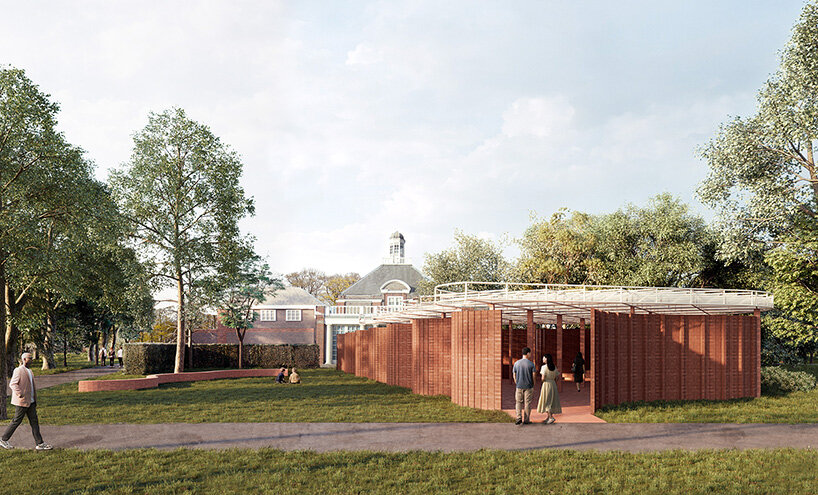
LANZA atelier’s proposal draws a historic English architectural feature composed of alternating curves
a geometry that achieves more with less
The completed structure translates these references into an architecture that is ancient and contemporary at the same time. Positioned on the northern side of the site, the pavilion is organized around curving brick walls and a lightweight translucent canopy supported by a grove-like arrangement of columns. The design establishes a dialogue with both the surrounding trees and the brick facade of Serpentine South Gallery, itself originally conceived as a tea pavilion.
Throughout the pavilion, walls dissolve into rhythmic assemblies of slender brick columns separated by narrow gaps. Visitors can see through surfaces that would traditionally obstruct vision, creating moments of visual exchange between people occupying different parts of the space. ‘They reveal the power of walls not to divide, but to bring together,’ the architects share with us. ‘People can see through a surface that is traditionally opaque, and eventually gazes can connect.’
The material language extends continuously across the floor and into integrated furniture elements, where brick surfaces form seating and the café counter, demonstrating what the architects describe as an interest in exploring the full potential of a single material. ‘We try to focus on one primary material for each project, to explore all possible uses,’ they note.
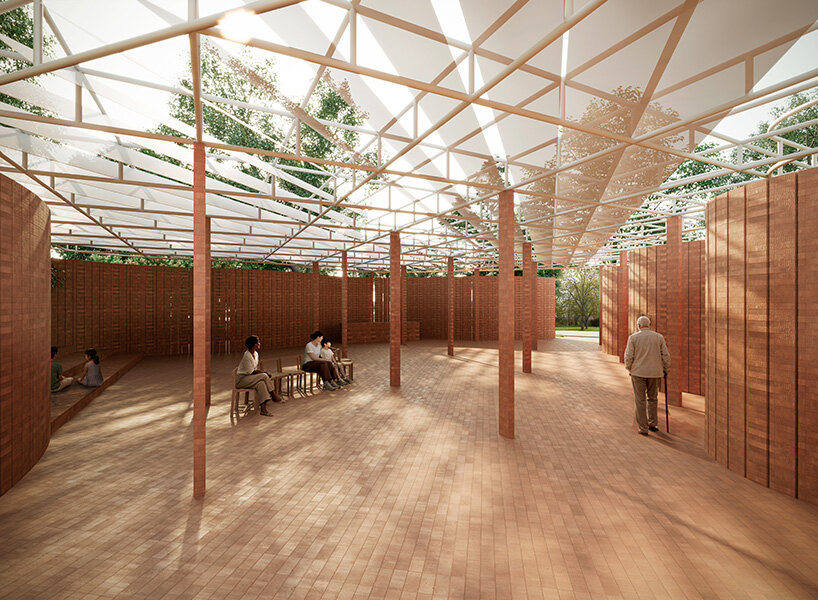
the serpentine wall gains its structural stability from its geometry
a shifting condition of enclosure
Above, a translucent roof composed of a spatial steel grid, polycarbonate panels, and Eco-Bau fabric fins filters daylight throughout the structure. ‘The marriage of traditional artisanal craft with high-performance technological materials is a contrast we welcome,’ they explain.
This balance between solidity and lightness ultimately contributes to what may be the most defining characteristic of the pavilion: its spatial ambiguity that does not establish a clear distinction between interior and exterior.
‘Spatial ambiguity is fundamental to most of our projects because it questions the boundaries between inside and outside,’ LANZA atelier tells designboom. ‘We are interested in creating an architecture that does not impose a singular condition, but rather constantly shifts between moments of intimacy and openness.’
The pavilion aims to form relationships and connections between built form, landscape, climate, and movement. The architects point out that the project extends beyond the covered area itself toward a curved brick bench positioned along the southern edge of the lawn. ‘Half of the Pavilion is covered while the other half remains open to the sky,’ they note. ‘This ambiguity encourages movement and discovery.’
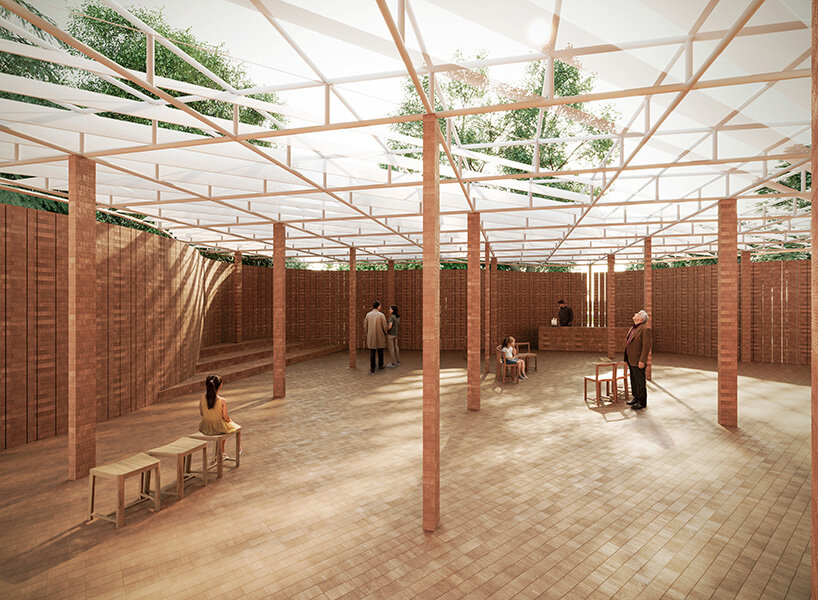
the pavilion is positioned on the northern side of the site and structured through two main walls
framing encounters through design
The result is an architecture that remains deliberately incomplete without its users. ‘The underlying question is: what can architecture do?’ the duo asks. ‘Or, more specifically, how can architecture foster more meaningful forms of social connection?’
For Abascal and Arienzo, the role of architecture is not to dictate behavior but to create conditions in which encounters can emerge. ‘We like the idea that architecture can frame relationships instead of controlling them,’ they say. In this sense, ‘a serpentine’ becomes a framework for collective experience, one that will host performances, conversations, screenings, workshops, family events, and Serpentine’s annual Park Nights program throughout the summer and into autumn.
This emphasis on relationships also informs LANZA atelier’s understanding of beauty, a recurring theme throughout their work. At a moment when architecture is often measured primarily through performance metrics and efficiency calculations, the architects reject the notion that beauty occupies a separate category.
‘To us, beauty is not opposed to performance or efficiency,’ they explain. ‘On the contrary, beauty often emerges from an intelligent response to material, climate, structure, and use.’
Once again, the serpentine wall itself becomes the clearest example. ‘Its curved geometry allows it to use fewer bricks while becoming structurally stronger and spatially seductive,’ they describe. ‘That is our idea of beauty.’
The landscape of Kensington Gardens further deepened these questions. Surrounded by one of London’s most celebrated public parks, the architects found themselves reflecting on the relationship their pavilion and the gardens. ‘Being in such an idyllic context as Kensington Gardens we feel it is the perfect time to discuss what the idea of a garden means and how an English garden is related to historical elements of architecture and ancient materiality,’ LANZA atelier shares with us.
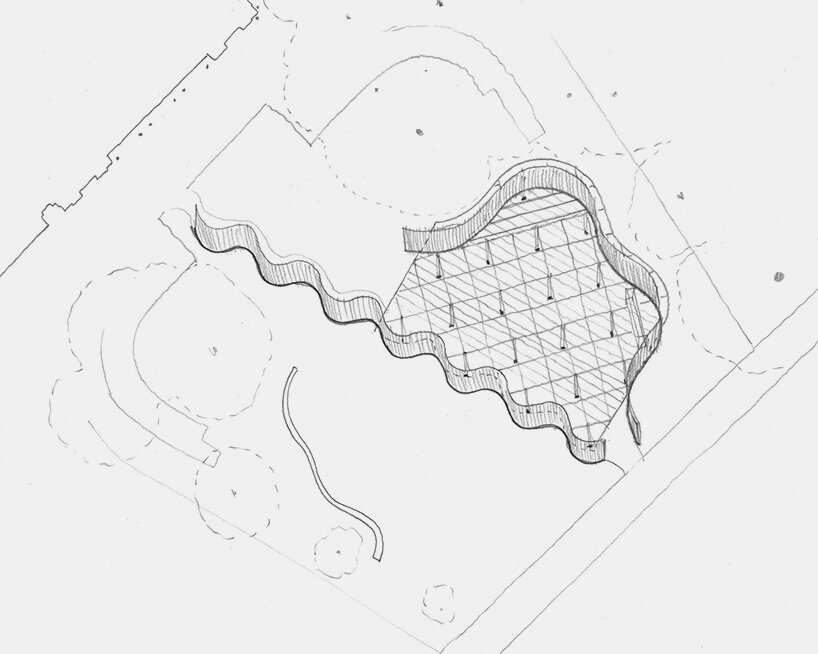
conceptual sketch, worm’s eye view | image © LANZA atelier, courtesy of Serpentine
finding paradise around a wall
Their reflections led them to the ancient Persian roots of the word ‘paradise’. ‘Many authors refer to the etymology of paradise, which comes from the Avestan word ”pairidaeza”,’ they point out. While commonly interpreted as a walled garden, LANZA atelier proposes an alternative reading. ‘We like to consider that in the encounter between around and wall, a compelling concept arises: the place that happens around a wall.’
The observation reveals much about the pavilion itself, a project that frames walls as catalysts for social and spatial life. ‘From our architectural perspective, paradise arises in the balance between human intervention and the natural context around it,’ the architects add.
As the pavilion opens to the public, LANZA atelier is particularly interested in the unpredictable ways visitors might inhabit the space. ‘While we have planned for some places to sit or observe, we know that visitors will surprise us with their interaction with the space and that is exciting,’ says Isabel Abascal. The architects are especially eager to see how performers, musicians, poets, and artists respond to the setting throughout Serpentine’s summer program. ‘We can’t anticipate how they will use the space and that is one of the beautiful things that architecture can accomplish, being able to host the unpredictable.’

Isabel Abascal and Alessandro Arienzo of LANZA atelier | image © Pia Riverola
adding a voice to the pavilion legacy
For Alessandro Arienzo, the material presence of the pavilion will play a central role in these encounters. ‘I do think the brick material is going to be well received; it’s a material we all have a relation to,’ he tells us. ‘But the way we are using it this time is so specific that we expect people to resonate with it. Materiality will be very present and we are excited about that.’
Although ‘a serpentine’ marks the 25th anniversary of the Serpentine Pavilion commission, LANZA atelier views the project as a contribution to an ongoing conversation spanning a quarter-century of architectural experimentation. ‘We are also adding our own voice to 24 previous voices that have left their mark on the Serpentine lawn,’ the architects reflect. Together, those projects form ‘a collage of the architecture of the first quarter of the 21st century.’
The architects hope their contribution carries a lesson embedded within the wall that inspired it. ‘We would like to encourage the global architectural community to be as clever as the Serpentine wall,’ they conclude, ‘by virtue of its unexpected shape which employs fewer materials than a straight wall and is stronger, more stable.’
LANZA atelier’s pavilion proposes that the future of architecture may lie in achieving more with less. Through a simple clay brick wall that curves, opens, shelters, and connects, ‘a serpentine’ revisits an ancient construction technique and transforms it into a contemporary argument for generosity, efficiency, and collective life.
project info:
name: a serpentine
architect: LANZA atelier | @lanzaatelier
lead architects: Isabel Abascal, Alessandro Arienzo
location: Serpentine South, Kensington Gardens, London, UK
event: Serpentine Pavilion | @serpentineuk
opening date: June 6th, 2026