
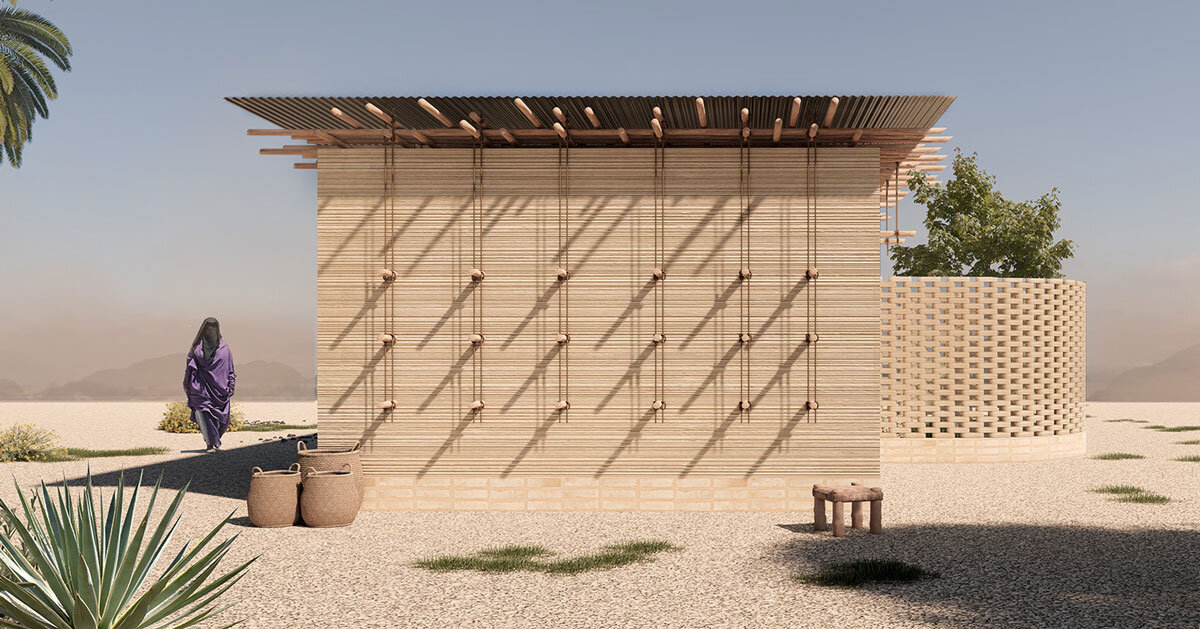
Flexible Modules Define an Affordable Shelter System in Somalia
Shelters of the Future is a modular housing concept created by Rabie Al Ashi for an international competition dedicated to low-cost shelter solutions for Internally Displaced Persons (IDPs) in Somalia. This competition was initiated by the Ministry of Public Works, Reconstruction and Housing (MoPWRH) and the International Organization for Migration (IOM – UN Migration), in partnership with the Young Architects Competition (YAC). The challenge invited architects to envision dignified, contextual, and resilient shelters for displaced Somali communities. Developed in collaboration with Kengo Kuma & Associates and guided by Anteo Taro Boschi Sanada, the project earned 1st Prize.
Drawing inspiration from Somali vernacular architecture, the proposal updates traditional building methods within a modern, community-oriented framework. At its core, the design utilizes a flexible 4×4 m spatial module—a straightforward, human-scaled unit that can be arranged in multiple ways. Each module includes two enclosed rooms, a semi-open central area, and a private garden, ensuring that families retain privacy, dignity, and respect for cultural spatial practices.
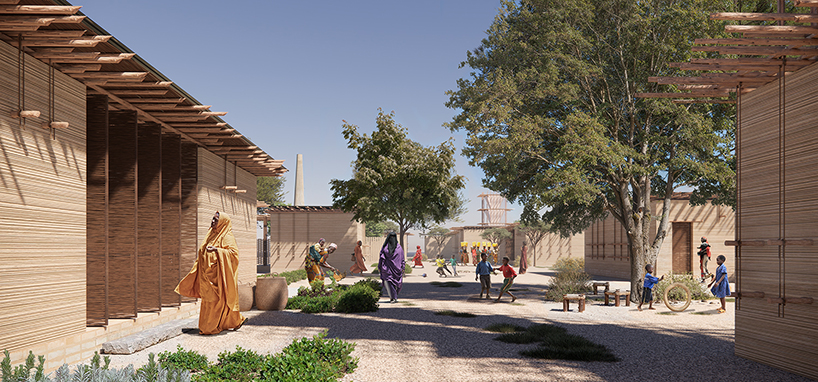
A modern reinterpretation of Somali vernacular architecture | all images courtesy of Rabie Al Ashi
Adaptive Modular Clusters Foster Community Living
This modular system is designed to grow organically, with units clustering in radial, linear, or courtyard layouts to form lively neighborhood environments that adapt to changing community needs. Such flexibility allows shelters to evolve from emergency housing into enduring, livable spaces. The design emphasizes local identity by using sustainable, renewable, and low-embodied-energy materials, including acacia logs, mud bricks, palm leaves, and natural earth finishes. The shelters are intended for low-tech, self-assembly—empowering residents, promoting local craftsmanship, and minimizing reliance on imported building systems.
Passive design principles are integrated throughout, utilizing cross-ventilation, thermal mass, natural shading, and breathable enclosures to improve comfort in Somalia’s hot, arid climate. The layout also considers gender sensitivity, provides areas for small-scale farming and livestock, and includes shaded communal spaces to encourage social bonds and support livelihoods. Conceived by designer Rabie Al Ashi, Shelters of the Future redefines humanitarian shelter as more than a stopgap solution. It offers a scalable, culturally resonant, and resilient framework that adapts with its residents, helping restore stability, dignity, and a sense of community for those experiencing displacement.
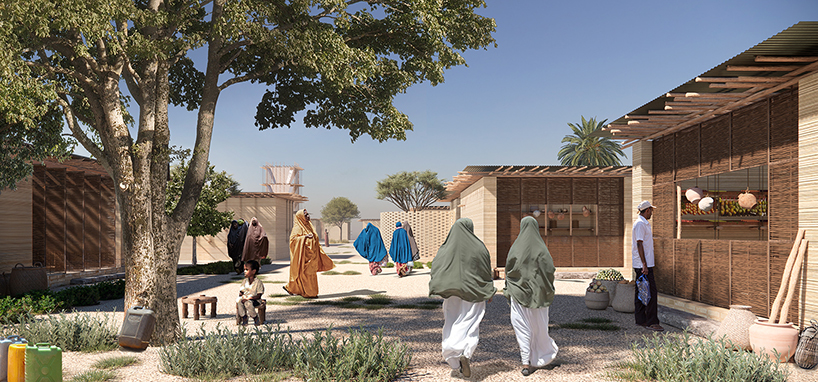
A modular neighborhood structure designed for scalable community development
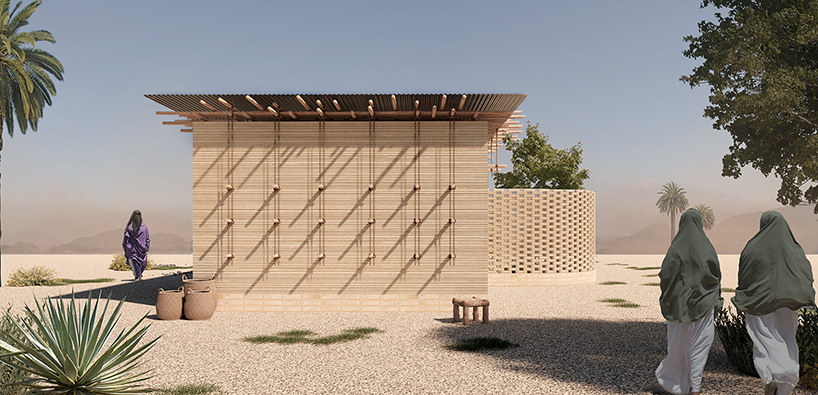
The design highlights the value of local materials and construction techniques