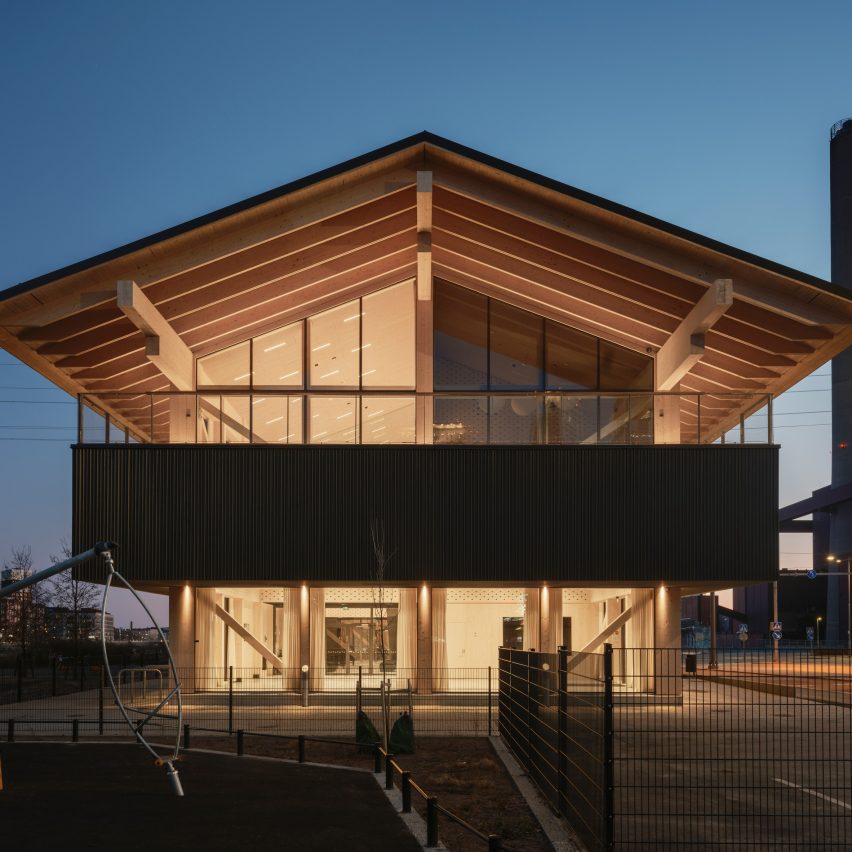

US architecture studio OPAL has created a farming research and education centre made with mass timber and modelled after the local barns on its site in Maine, weaving together “tradition and modern sensibility”.
The Smith Center for Education and Research, also known as Grange Life, comprises 8,800 square feet (817 square metres) on the 500-acre Wolfe’s Neck Center for Agriculture and the Environment, a nonprofit farming organisation in Freeport, Maine.

OPAL – based in Belfast, Maine – said it designed the Smith Center ecologically from the ground up so the building can pay back its entire embodied carbon debt during its usable lifetime.
“The superinsulated, all-wood assembly reduces energy use and sequesters carbon, while the generous, climate-specific, triple-glazed curtain walls gain more energy from the sun than they lose through heat loss,” the studio told Dezeen.

Horizontal, white clapboard and unfinished cedar siding wrap the structure in a neutral palette that blends into the agrarian context, while large spans of south-facing glazing open the interiors to views of the fields and ocean beyond.
“The architecture draws on the rich tradition of New England agricultural building forms while weaving in a modernist sensibility,” the studio said, explaining that the building’s two gabled forms mediate the scale of the traditional farmhouse and large dairy barn nearby, while following the footprint of a former dairy barn.
The two south-facing sloped roofs hold a 44 kW solar array on the outside, while inside, the parallel gables create peaked classroom spaces, connected by a lower flat form that holds the service areas.
With two main facades, the circulation axes run east to west, bridging the parking areas, new garden spaces and existing farms with a social hub that can flex for seminars, conferences, community events and youth camps.

A large meeting space on the south side of the building serves as its focal point, showcasing the glued-laminated members made from fir alongside unfinished pine ceiling slats.
Concrete floors flow from the meeting room through the commercial kitchen, which allows the organisation to prepare meals from the farms’ produce, to the classrooms on the other side of the building – outfitted with birch plywood casework.

Galvanised steel awnings mark the entrances while a reclaimed wood reception desk serves as a sustainable, welcoming feature.
“The biggest success of this project was meeting the clients’ needs and expectations for function and quality of spaces while achieving significant energy use reductions from national average for this use type,” the studio said, explaining that the design seamlessly integrates building ecology without sacrificing light, function or spatial quality.
“The building uses over 60 per cent less energy than comparable buildings.”
Other educational and research buildings recently completed in Maine include a cedar-clad welcome centre for the Katahdin Woods and Waters National Monument by Saunders Architecture, an ecology centre for the College of the Atlantic in Bar Harbor by Susan T Rodriguez Architecture & Design and the forthcoming GEM Factory of the Future at the University of Maine by Grimshaw.
The photography is by Trent Bell.
Project credits:
Architecture: OPAL
OPAL design team: Timothy Lock, Gabe Tomasulo, Dan Rodefeld,
Interior & graphic design: Molly Quesada
Contractor: Zachau Construction
Civil engineer: Thomas Fowler
Structural engineer: Thornton Tomasetti
Mechanical, electrical & plumbing engineer: Taitem
Landscape: Michael Boucher Landscape Architecture