
i/thee lets matter take part
Experimental design studio i/thee treats softness as a way of working with the world, giving agency to mud, algae, paper, wood, weather, and play. Across public installations, experimental shelters, and landscape pavilions, the studio builds through exchange instead of command.
Materials are poured, eroded, laminated, stacked, or cast into the ground, then allowed to carry traces of gravity, touch, climate, and chance. The work is generous as it asks architecture to listen before it takes shape.
The team describes its practice through the idea of ‘cosentience,’ a term which it uses to connect living and nonliving things. That sensibility gives the work its unusual tenderness. A pavilion can behave like a puddle. A play structure can invite adults back into bodily curiosity. A paper shelter can begin in a hole dug into the earth. In each case, the studio’s architecture gains its form through contact.
The studio’s work is tactile, strange, and often joyful. It asks serious ecological questions through spaces that invite people to gather, climb, sit, look, and move.

i/thee, studio portrait. image courtesy the architects
a puddle becomes a pavilion
The most direct expression of this thinking appears in Puddle Pavilion (read here), a free-form canopy hovering above Mud Creek in Bondurant, Iowa. Designed from algae-based bio-resin, the structure was cast directly on the ground with no formwork. Liquid resin spread across the surface, gathering into uneven edges and layered thicknesses before curing into a translucent sheet. Once lifted onto its supports, the puddle became a public canopy.
The project is compelling because it keeps the memory of its making visible. Its surface suggests water caught mid-movement, with a shape guided by gravity as much as by the studio’s hand. As a public structure, it offers shade and a point of pause along the creek, yet its larger proposition is material. Algae-based resin becomes a way to imagine construction beyond petroleum plastics, while the casting process reduces the need for wasteful molds.
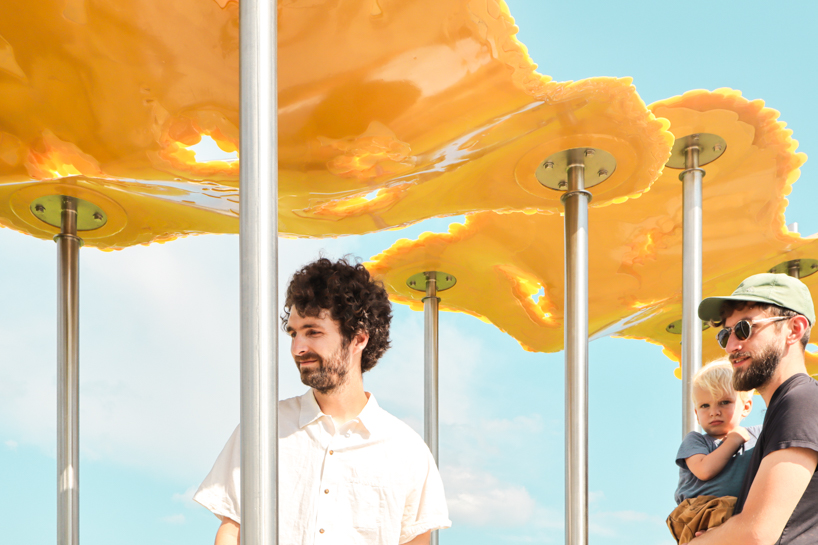
Puddle Pavilion, i/thee, Iowa, USA, 2025. image courtesy the architects
erosion as public infrastructure
At Lake Petocka in Bondurant, i/thee’s The Dining Room extends this interest in landscape and process through rammed earth. The installation creates a public dining and picnic area through two earthen walls that appear worn away to reveal benches, tables, and usable surfaces. ArchDaily describes the project as an earthen pavilion that uses natural forces to shape public infrastructure.
Here, weathering becomes part of the architecture’s language. The walls feel as though they have been slowly opened by time, giving the picnic area a sense of age beyond its actual construction. The project turns public seating into a conversation with erosion, soil, and communal use. It suggests that civic space can be durable without feeling sealed off from change.

The Dining Room, i/thee, Iowa, USA, 2024. image courtesy the architects
play as a spatial ethic
i/thee’s softness also comes through play. ReEmber Playland, completed in Amboy, California, was designed as a recyclable adult playland for Teva’s ReEmber collection. Built from interchangeable set pieces against the Amboy Salt Flats, the installation encouraged users to climb, pose, rearrange themselves, and move through a surreal desert playground.
The project could have become a simple branded set, yet i/thee turned it into a small choreography of bodies and objects. Its value sits in the invitation to loosen up. Adults are given permission to test balance, gesture, and scale, while the landscape amplifies the sense of estrangement. Within the studio’s wider body of work, play becomes a method for making people more receptive to their surroundings.

ReEmber Playland, i/thee, California, USA. image courtesy the architects
paper, earth, and the scale of shelter
With Agg Hab, i/thee and Roundhouse Platform tested a more speculative kind of dwelling. The prototype, built in Texas, was formed by casting papier-mâché strips into sculpted holes in the ground. The project used recycled paper and non-toxic glue to create shell-like structures, turning a familiar craft material into an experimental eco-dwelling system.
Agg Hab is important because it gives low-status material a new architectural seriousness. Paper carries associations of fragility, disposability, and childhood making, yet here it becomes structure. The earth acts as mold, workshop, and collaborator. The project feels rough in the best sense, opening a path for architecture that begins with discarded matter and hand-based processes instead of industrial polish.

Agg Hab, i/thee and Roundhouse Platform, Texas, USA, 2020. image courtesy the architects
a flexible frame in woodstock
At the historic grounds of the 1969 Woodstock Music and Art Fair in Bethel, New York, i/thee created Peak-A-Boo (read here), a wood-laminate pavilion formed from continuous arches and decks. The structure operates as a flexible performance space, peeking through the trees with a geometry that feels both digital and handmade.
Unlike the fluid surface of Puddle Pavilion or the eroded mass of The Dining Room, Peak-A-Boo works through rhythm. The repeated arches create a porous frame for music, rest, and gathering. Its openness gives the site a renewed social use while still acknowledging the cultural memory of Woodstock. The project shows how temporary architecture can hold collective energy without hardening into monumentality.