The completed Obama Presidential Center represents a concerning shift in the image ex-presidents want to convey, writes Anthony Paletta.
It’s a rare moment to have not one, but two presidential libraries prominent in the news. Typically the domain of a sort of quaint, civic Americana, the present two – the now-open Obama Presidential Center and the preliminary-rendering-phase Trump library – represent towering swerves from the model.
Just like the presidencies themselves, both have received mixed reactions and seem to defy popular ideas of what a presidential library should be. It’s doubtful that many Americans even recognize the buildings of the preceding presidents, but observers are not remotely wrong that these two are departures.
Most presidential libraries have made a real effort not to draw much attention to themselves
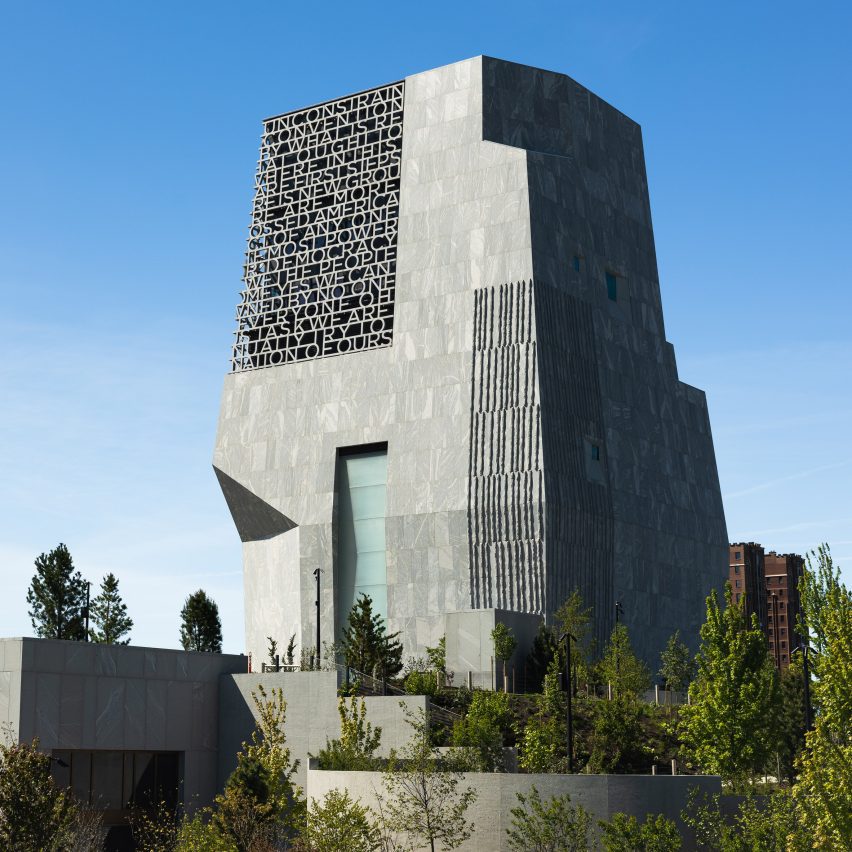
The Tod Williams Billie Tsien Architects-designed Obama Presidential Center in Jackson Park and Bermello Ajamil’s Trump Presidential Library in Miami are both uncharacteristically tall buildings. The former features an Obama quotation on its side; the latter naturally features Trump’s name at its top.
Most presidential libraries have made a real effort not to draw much attention to themselves. The contradiction at their core is that they are shrines to their subjects, and yet tend to be fairly circumspect about that fact.
However imperial the various presidencies might have been, there’s a real tendency towards restraint in these monuments. This seems unquestionably good for the health of a democratic society, even if its merits for architecture are decidedly less certain.
These are continued exercises in image management, and almost every president has steered away from the overly grandiose statement. Most of the results aren’t actively ugly, but rather wilfully modest.
The Obama library is an aesthetically intriguing contemporary turn, a largely windowless granite-clad sculptural monolith that its architects have likened to a lantern.
Early in the design process, Billie Tsien expressed a desire “to relate to the limestone buildings of the University of Chicago’s Neo-Gothic campus” – but relation usually doesn’t entail resemblance when architects are talking. The studio purposefully sought out distinguishing tapestry-granite cladding, and pursued a very different look from the nearby university.
Even the theoretically adventurous entries tend to dodge brashness
Many don’t seem to care for it, and not merely those in the Fox News quadrant. Its height, lack of fenestration, and aggressively modern form have drawn baffled responses locally. The building is unquestionably artful, but maybe there is a mismatch between a daring form and the inchoate idea of what a building of this purpose should look like.
Presidential libraries have generally followed the model of the first – Franklin Delano Roosevelt’s in Hyde Park. They tend to be low-slung and look like libraries, concealing the principal reason why visitors come by: lionizing exhibitions about the buildings’ namesakes. The archives are generally entirely out of sight; you can get a rare glimpse of file boxes in the atrium of Lyndon Johnson’s library, but the average visitor is unlikely to open even one.
Many presidential libraries are on college campuses or take on a collegiate appearance. The Nixon and Reagan libraries stand alone, but sport this look. George HW Bush’s HOK-designed library at Texas A&M and RAMSA’s George W Bush library at Southern Methodist University closely comports with the look of the Neo-Georgian campus. Truman, Ford, and Carter all built humble structures.
The best-known entry in the field is almost certainly IM Pei’s Kennedy Library, the only one by a talent that we might call a starchitect. It’s difficult to separate this splashier-than-average undertaking from its status as a posthumous tribute by Jacqueline Kennedy Onassis, who was the driving force behind Pei’s selection.
Even the theoretically adventurous entries tend to dodge brashness. Bill Clinton’s library in Little Rock ended up as a work of classic triangulation. He did not pick a showboat architect but rather Jim Polshek, a liberal-minded architect of great skill but one rarely given to statement buildings.
Clinton did not ask for a monument to himself but did ask for a grand image, that of a bridge. Polshek delivered something near to that, but it was perhaps an awkward task imposed on an architect who was rarely given to these sort of large gestures.
The shortlist for the Obama project involved firms that almost certainly would have delivered a more imposing building
The Obama library aimed for a similar symbol – of four hands joining together – but you could be forgiven for not quite seeing that. Tsien Williams is a selection reminiscent of Polshek in more than a few ways; it is a superb firm but better known for subtle contextual work than for grandiose statements.
The shortlist for the Obama project involved firms that almost certainly would have delivered a more imposing building, such as David Adjaye and Renzo Piano. There was a familiar sort of equivocation at work, however, in picking a subdued firm and then prodding them in directions somewhat more bombastic than their typical mode.
The building was reportedly made taller at Obama’s request. The quotation on its side was also his idea.
We do have one prior example of the presidential library as utter shamelessness in Gordon Bunshaft’s library for Lyndon Johnson in Austin. LBJ was never tempted by modesty.
Robert Caro has described presidential libraries as “America’s Pyramids”, but pharaonic imagery is what most other presidents have avoided. Most have not hired architects as enormously talented as Bunshaft, capable of delivering such a thing without a hint of irony. It’s a striking entry, but it seems healthy that most presidents have baulked at this level of brazenness.
Benjamin Huffbauer, in his 2007 book Presidential Temples: How Memorials and Libraries Shape Public Memory, wrote that “presidential libraries have largely replaced monuments for presidents in the nation’s capital”. FDR didn’t have an actual monument until 1997, and Eisenhower didn’t have one until 2020.
The Obama complex amounts to a demand for attention
The current president has declined to wait, naming things after himself while in office. His skyscraper library proposal seems yet another landmark of self-celebration, the first skyscraper for a presidential library. It will also likely include a hotel, yet more natural self-aggrandisement.
By contrast, the Obama complex includes a very welcome amount of community facilities – from a community library to basketball courts and yet it also amounts to a demand for attention – eight stories that will dominate its surroundings.
It is a very interesting building, which unquestionably breaks free of tired precedent. And yet it’s difficult not to mourn an era in which ex-presidents found humility – and not monumentality – the most important image they wished to cultivate.
Anthony Paletta is an architecture journalist based in New York City. His writing has appeared in The Wall Street Journal, The Guardian, Bloomberg CityLab, The Architect’s Newspaper and Metropolis, among others.
The photo is courtesy of the Obama Foundation.
Dezeen In Depth
If you enjoy reading Dezeen’s interviews, opinions and features, subscribe to Dezeen In Depth. Sent on the last Friday of each month, this newsletter provides a single place to read about the design and architecture stories behind the headlines.
The post "The Obama Presidential Center unquestionably breaks free of tired precedent" appeared first on Dezeen.